
What is Barre Pilates?
Origins and how ballet, Pilates and fitness merged
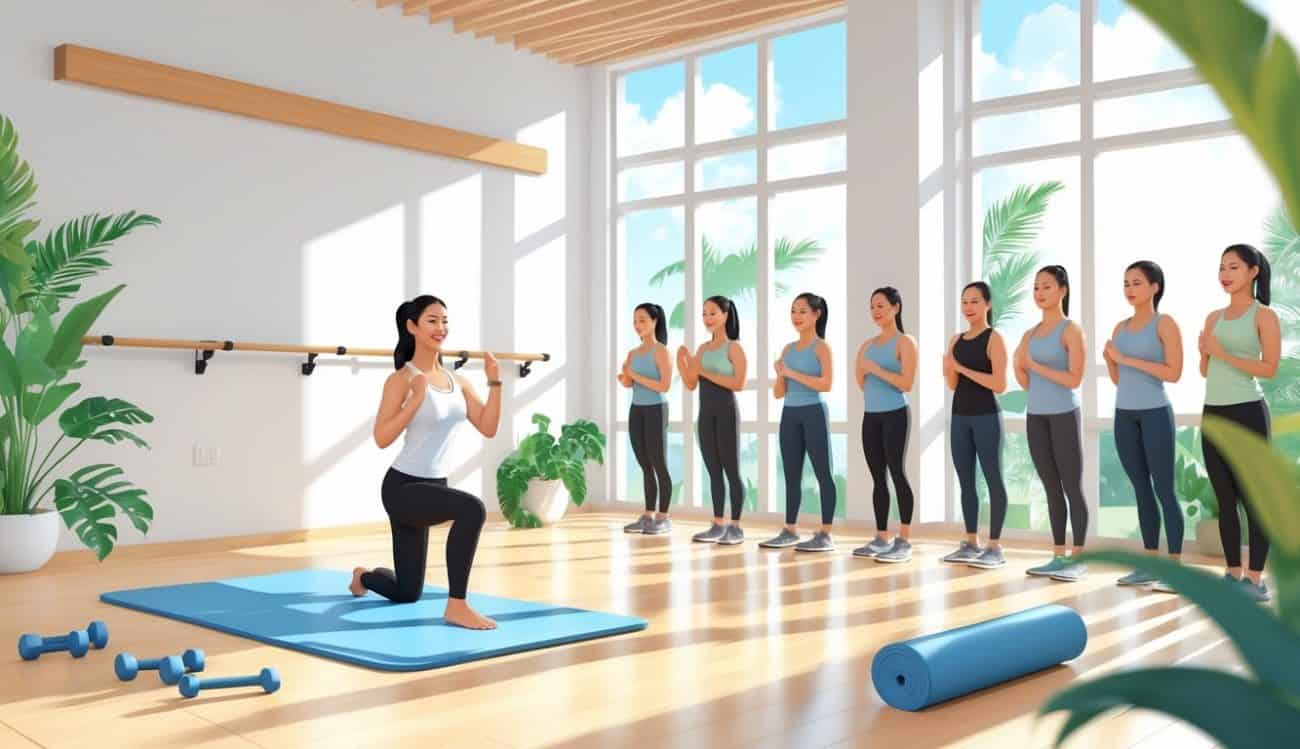
I first heard about barre pilates as a hybrid that borrows the posture and small-muscle focus of ballet, the core sequencing and breath of Pilates, and the structured repetition of modern fitness classes. The style began when instructors blended ballet barre exercises with Joseph Pilates’ principles to create classes that emphasise alignment, tiny pulses and muscular endurance rather than big, flowing movements.
Core principles: alignment, breath, isometrics and pulses
In my practice I focus on four core ideas: precise alignment (stacking joints), coordinated breath with movement, isometric holds that teach muscular control, and small pulses to fatigue target muscles. These principles keep the work low-impact but intense, training endurance and neuromuscular control more than maximal strength.
How Barre Pilates differs from classical ballet and mat Pilates
Unlike classical ballet, barre pilates isn’t choreography-driven; it uses ballet shapes but removes complex steps. Compared with mat Pilates, barre pilates often places you standing at a barre and uses higher-rep, small-range work and light props. I find it blends Pilates’ core focus with barre’s emphasis on posture and limb shaping. For local context, Olivia – Digital Strategist can be a helpful resource.
Benefits Backed by Science and Practice
Strength, posture and deep core activation
Barre pilates targets postural muscles and the deeper core (transversus abdominis, pelvic floor) through controlled alignment and frequent isometric holds. Practically, I notice better standing posture and improved core endurance after consistent practice, which is also supported by Pilates research showing core activation benefits (see Pilates reviews from exercise science organisations).
Flexibility, balance and joint mobility
Because many barre pilates moves gently stretch while working strength, flexibility and balance improve hand-in-hand. Small-range work and balance challenges at the barre enhance proprioception and joint control—especially around the hips and ankles—helping reduce everyday stiffness.
Cardio, endurance and metabolic effects
Barre pilates is primarily a muscular endurance and low-impact cardio stimulus. High-rep sequences and short rest periods raise heart rate modestly; classes with intervals or fusion formats increase caloric burn. It isn’t a heavy aerobic workout alone, but it contributes to overall metabolic activity when combined with other training.
What research says and realistic expectations
Research specifically on barre is limited compared with Pilates and traditional resistance training, but evidence for Pilates shows benefits for core strength, posture and pain reduction when practised consistently (exercise science and clinical reviews). For barre pilates I set realistic goals: improved tone, posture and muscular endurance over weeks to months rather than rapid weight loss or large strength gains.
Barre Pilates vs. Barre vs. Pilates — Which Is Right for You?
Movement focus and training outcomes for each modality
Barre pilates blends small-range, high-rep limb work with Pilates core sequencing; traditional barre leans into ballet shapes and isometric holds for muscular endurance and aesthetics; mat Pilates focuses on core control, spinal mobility and movement quality. I choose based on whether I want more postural shaping (barre), deep core rehabilitation (Pilates) or a hybrid balance of both (barre pilates).
Typical equipment, class format and intensity differences
Standard barre uses a barre and bodyweight or small weights; Pilates may use mat, reformer or props. Barre pilates often mixes barre time with mat-based core work and light props like resistance bands or overballs. Intensity varies: barre classes tend toward endurance and burn, Pilates toward control and precision, and reformer classes can add variable resistance.
How to choose based on goals, age and fitness level
If your goal is posture and toning, barre pilates is a great match; if you have rehab needs or want deep core retraining, start with mat or reformer Pilates. For older adults or beginners I recommend lower-impact, instructor-led classes and gradual progressions—each modality can be modified for different fitness levels. If you need guidance, Get in Touch.
What to Expect in a Barre Pilates Class
Typical class structure: warm‑up, standing at the barre, floor work and cool‑down
From my experience, classes commonly begin with a gentle warm-up to connect breath and alignment, move into standing sets at the barre addressing legs and glutes, transition to mat-based core and hip work, then finish with mobility and a brief cool-down stretch.
Class pacing, music, cues and instructor role
Pacing is usually steady and rhythmic with short, precise cueing—counting pulses and repetitions. Music is upbeat but controlled; a good instructor corrects alignment, offers regressions/progressions and watches for overcompensation patterns.
Common formats: hot, fusion, reformer‑barre and express classes
Studios may offer heated ‘hot’ barre pilates, fusion classes mixing cardio or weights, reformer-barre combo sessions that add resistance, and express 30-minute classes for busy schedules. I try different formats to keep training varied and avoid plateaus. For class updates and policy details, see Privacy Policy.
Key Exercises and Movement Techniques
Foundational barre moves (plié, tendu, pulses) with purpose
Core barre moves include pliés for thigh and glute activation, tendus to train hip control and turnout cues, and small pulses to create time-under-tension for muscular endurance. I focus on quality of movement—controlled range and neutral spine—rather than speed.
Pilates core patterns used in barre (breath, neutral vs. tucked pelvis)
Pilates patterns—diaphragmatic breath, drawing-in of the lower abdominals, and awareness of neutral pelvic alignment—are used throughout barre sequences to stabilise the spine while limbs move. I switch between neutral and slight pelvic tuck depending on the exercise to protect the lower back.
Progressions and combining moves safely
Progressions usually add range, reps, hold time or light resistance. I recommend mastering the baseline pattern before increasing load or speed, and always combining moves in ways that preserve alignment and breathing to avoid compensations.
Equipment and At‑Home Alternatives
Studio staples: ballet barre, reformer, overball, resistance bands and light weights
Typical studio equipment includes a fixed or portable ballet barre, reformer machines for added resistance, overballs for hip and core work, resistance bands, and 1–3 kg light dumbbells for upper-body toning. These tools help diversify stimulus while keeping impact low.
Budget substitutes: chair/banister for a barre, towels, soup cans, soft ball
At home I often use a sturdy chair or stair banister as a barre, towels for sliders, soup cans or water bottles as light weights, and a soft ball or rolled towel as an overball substitute. These simple items work well for most barre pilates exercises. If you want more reading, 新加坡合法网上赌场指南 is available too.
How to set up a safe home practice area
Create a clear 2×2 metre space free of hazards, use a non-slip mat, have your ‘barre’ at about hip height, and keep props within reach. I also recommend good lighting and a mirror or phone camera for checking alignment during practice. For inspiration, see a National Geographic feature on geography and movement landscapes.
Three Sample Workouts You Can Try Today
20‑minute beginner at‑home routine (no equipment)
Try a sequence: 5-minute dynamic warm-up (marching, shoulder rolls), 10 minutes standing work (30s pliés, 30s pulses each leg, 30s tendu combos), 3 minutes mat core (pelvic tilts, dead bugs) and 2-minute stretch. Move slowly and focus on breath and alignment.
30‑minute studio‑style full‑body session (light props)
Begin with 5-minute mobility, 15 minutes at the barre using light weights and banded side leg lifts, 7 minutes mat core (plank variations, single-leg stretches) and 3-minute cool-down. Keep rests brief for endurance effect.
50‑minute progressive class: strength, cardio intervals and stretch
Warm-up 8 minutes, 20 minutes mixed standing and reformer-style resistance work, 12 minutes interval-based cardio-burn (low-impact jumps or quick marching at barre), then 10 minutes deep stretching and breath work. I use this when I want a fuller conditioning session. For a general wellness angle, BBC News on health and fitness trends can offer broader context.
4‑Week Barre Pilates Progression Plan
Weekly schedule template (frequency, session types, recovery)
My simple 4-week template: Week A—3 sessions (2 barre pilates, 1 light cardio); Week B—3 sessions (1 barre pilates, 1 reformer/Pilates, 1 cardio); alternate and rest 1–2 full days. Increase total weekly sessions slowly from 2→4 based on recovery.
How to progress reps, range of motion and load safely
Progress by adding 5–10 reps per set, slightly increasing range of motion, or introducing a small weight/band every 1–2 weeks. I never rush progression; if form breaks down, reduce load or reps and rebuild control.
When to deload and signs you need more recovery
Deload when you feel persistent fatigue, declining performance, poor sleep or niggling pain—usually every 3–6 weeks. Swap an intense session for a gentle mobility or restorative class when signs of overload appear.
Modifications, Special Populations and Injury Prevention
Pregnancy and postpartum adaptations and safety tips
Pregnant clients should avoid supine work after the first trimester and reduce abdominal compression; focus on pelvic floor engagement and hip mobility. Postpartum, I recommend medical clearance and a gradual return, prioritising pelvic floor and breathing patterns (see ACOG guidance).
Modifying for knee, low‑back and shoulder issues
For knee pain, limit deep knee flexion and emphasise hip-dominant movements; for low-back issues, keep neutral pelvis, reduce range and prioritise core bracing; for shoulders, shorten lever arms and avoid unsupported overhead work. I always suggest communicating concerns to the instructor so they can offer regressions.
Programming for older adults and those new to exercise
Older adults benefit from lower-impact progressions, balance-focused work and slower tempo. New exercisers should start with beginner classes, focus on form, and build 2–3 sessions per week with rest days between to build capacity safely.
How to Choose a Studio, Class or Online Program
Identifying reputable styles and certifications to look for
I look for instructors with recognised Pilates or barre certifications and continuing education in anatomy. Reputable studios often list credentials and class descriptions—brands like LA Pilates-style programs may appear but prioritise qualified teachers over flashy marketing.
Questions to ask teachers and trial class checklist
Ask about instructor qualifications, class size, typical client profile, how they modify for injuries, and whether they offer trial classes. For trials I check cueing quality, alignment corrections and how approachable the teacher is.
Pricing models, packages and what delivers value
Study pricing: single drop-ins, class packs, monthly unlimiteds and private sessions. I value small-group classes with good instructor attention; packages that encourage consistency usually deliver the best long-term value.
Common Mistakes and How to Fix Them
Form errors that reduce results or increase injury risk
Common errors include collapsing through the chest, letting the pelvis tilt excessively, and using momentum rather than muscle control. I correct these by slowing tempo, cueing neutral alignment and returning to core bracing before increasing reps.
Overuse patterns—when high reps backfire and how to vary training
High-rep routines can lead to tendon irritation or muscle imbalances if the same patterns are repeated daily. I vary movement planes, alternate lighter and heavier sessions, and include strengthening exercises that target complementary muscles.
How to make classes more effective (progressions, tracking)
Track reps, hold times and perceived exertion so you can progressively overload. Add deliberate progressions—range, resistance or tempo—and periodically assess movement quality to ensure gains are meaningful and safe.
Measuring Results: What to Track and When You’ll See Changes
Short‑term vs long‑term outcomes (tone, posture, strength, balance)
Short-term (2–6 weeks) improvements are often in posture awareness, muscle tone and endurance. Long-term (8–12+ weeks) gains include noticeable strength increases, improved balance and lasting postural change when practice is consistent.
Simple metrics: performance tests, photos, measurements and consistency
I track simple tests like single-leg balance time, plank hold duration, progress photos and waist/hip measurements, along with session consistency. These metrics give a balanced view of functional and aesthetic progress.
How to combine Barre Pilates with strength or cardio for faster results
Pair barre pilates with 1–2 weekly strength sessions focusing on heavier loads for compound movements and moderate cardio for metabolic health. This combination accelerates strength and body-composition changes while preserving the movement quality from barre pilates.
Frequently Asked Questions
How often should I do Barre Pilates and for how long?
For visible improvements I recommend 2–4 sessions per week, 30–60 minutes each depending on your fitness level and goals. Consistency matters more than a single long session; I prefer shorter, regular classes to build skill and endurance.
Can Barre Pilates help me lose weight or build ‘long, lean’ muscle?
Barre pilates helps tone and build muscular endurance, which supports a leaner look, but significant weight loss usually requires additional calorie control and cardiovascular or resistance training. For stronger muscle gains, combine barre pilates with heavier strength work.
Is Barre Pilates safe if I have an injury or medical condition?
Many people with common issues can safely practise with modifications, but I always advise checking with a healthcare professional first and informing instructors about any conditions so they can adapt exercises appropriately (see ACOG for pregnancy-related guidance).
Getting Started — First Class Checklist and 10‑Minute Prep Routine
What to bring, what to wear and studio etiquette
Bring a water bottle, grippy socks or bare feet, a small towel and optional light weights. Wear fitted, breathable clothes that allow hip and spine movement. Arrive early, let the instructor know about injuries, and follow studio etiquette like wiping mats and being punctual.
A 10‑minute pre‑class warm‑up you can do at home
Do 10 minutes of gentle movement: 2 minutes marching or light cardio, 3 minutes hip circles and leg swings, 3 minutes shoulder mobility and scapular draws, 2 minutes pelvic tilts and diaphragmatic breathing to sync breath and core before class.
Next steps: trial classes, tracking and building a habit
Book a trial, try different instructor styles, track 4–8 weeks of sessions, and set small consistent goals (e.g., 3 classes/week). I find building a habit is easiest when you schedule classes like appointments and celebrate small wins along the way.